Clinical research is being transformed by AI at every stage — from how protocols are designed to how regulatory submissions are packaged. But most teams adopt AI tools in isolation, missing the compounding value of a connected workflow.
This series maps the complete AI stack for clinical research: eight workflow stages, each with specific tool recommendations, comparison tables, implementation guidance, and integration points to adjacent stages. Whether you’re a clinical operations lead, a site coordinator, or a principal investigator, these guides are built to help you make practical AI adoption decisions.
📋 Want the big picture first? Read the complete end-to-end overview — The Complete AI Stack for Clinical Research (2026) →
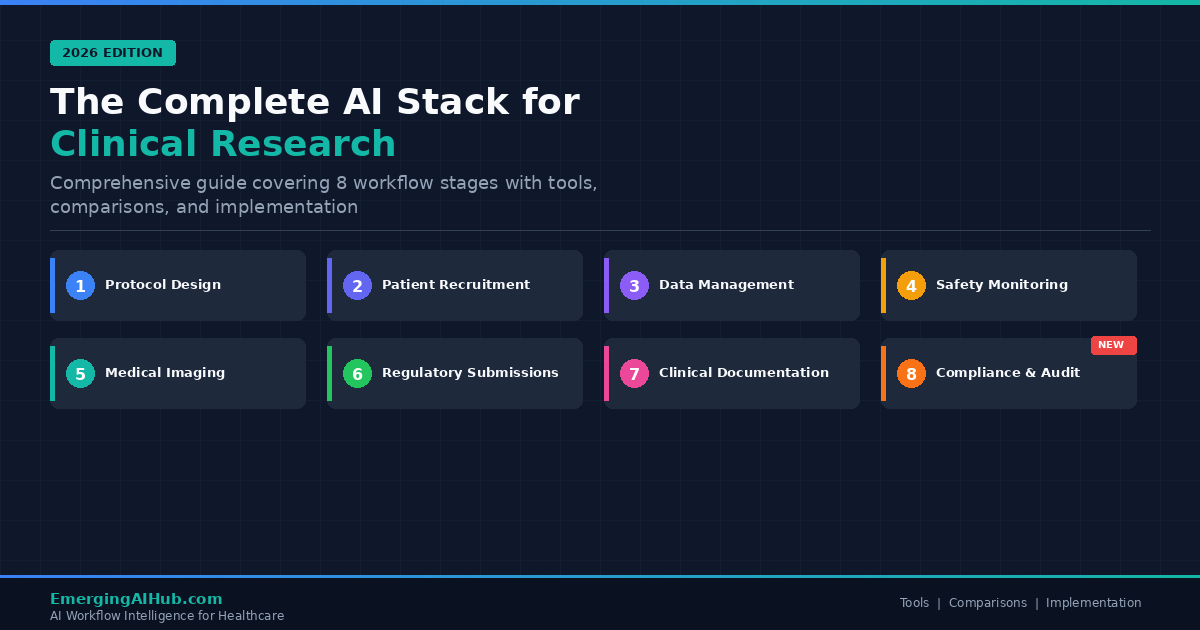
The 8 stages of the Clinical Research AI Stack
1. Protocol Design & Simulation
AI tools for protocol drafting, eligibility criteria optimization, feasibility testing, and trial scenario simulation. Covers TriNetX, Medidata AI, nQuery, Clinion eProtocol, and Unlearn.AI — with a 5-tool comparison matrix and step-by-step implementation guide.
2. Patient Recruitment & Matching
AI-powered patient identification from EHRs, automated eligibility screening, and trial matching platforms that cut recruitment timelines from months to days. Covers Deep 6 AI, Antidote Match, BEKHealth, and Dyania Health.
3. Clinical Data Management
EDC automation, AI-powered data cleaning and anomaly detection, CDISC standardization, and real-time data quality monitoring. Covers Saama Technologies, Veeva Vault CDMS, and Medidata Rave with workflow automation via Make.com.
4. Safety Monitoring & Pharmacovigilance
Real-time adverse event detection, AI-driven signal monitoring, predictive risk modeling, and automated safety reporting for proactive trial oversight. Covers Aetion, Oracle Argus Safety, and ArisGlobal.
5. Medical Imaging AI
AI tools for lung CT analysis, chest X-ray screening, automated RECIST measurements, and DICOM/DICOMweb integration for clinical trial imaging workflows. Covers MONAI, Aidoc, Viz.ai, and Annalise.ai.
6. Regulatory Submissions
AI-assisted CSR generation, eCTD submission packaging, cross-document consistency validation, and literature review automation. Covers Veeva Vault Submissions, Elicit for research synthesis, and Anju TA Scan.
7. Clinical Documentation & Scribing
AI medical scribes for automated transcription, clinical note generation, and structured documentation. Covers Abridge, Heidi Health, Fireflies.ai for meeting capture, and the Plaud NotePin S hardware recorder.
8. Compliance & Audit Readiness
AI tools for regulatory compliance monitoring, audit trail automation, HIPAA/GxP risk management, and regulatory change tracking. Covers RegASK, Centraleyes, Veeva Vault QMS, Clinion Responsible AI, and IQVIA SmartSolve — with a 5-tool comparison matrix and step-by-step implementation guide.
Tools & resources
AI Stack Builder — Build a custom AI stack based on your specific workflow needs.
Clinical Research AI Platform — Interactive dashboard mapping AI tools across the full trial lifecycle.
All AI Healthcare Stacks — Return to the main stacks directory.
Stay updated: New stack guides publish weekly. Subscribe to AI Stack Weekly for notifications and healthcare AI insights.