
Introduction: Why Compliance Is the Most Underinvested Layer of the Clinical Research Stack
Every stage of a clinical trial — from protocol design to regulatory submission — generates compliance obligations. Audit trails, GxP validation, HIPAA safeguards, ICH-GCP adherence, 21 CFR Part 11 documentation, and regulatory change management aren’t optional add-ons. They’re the substrate on which the entire trial stands or collapses.
Yet compliance has historically been managed reactively: spreadsheets, manual audits, siloed documentation, and a scramble to assemble evidence packages when an inspection notice arrives. The cost of this approach is staggering. Industry estimates place the average cost of a clinical trial compliance failure — including FDA warning letters, consent decree remediation, and delayed submissions — in the tens of millions of dollars. Even a single 483 observation can delay a product launch by months.
AI is now making proactive, continuous compliance operationally feasible. In 2026, the shift is from periodic audits to real-time compliance monitoring — where AI systems continuously scan for regulatory changes, flag protocol deviations before they become findings, automate audit trail generation, and maintain inspection readiness as a steady state rather than a fire drill.
This guide covers the AI tools and platforms purpose-built for compliance and audit readiness in clinical research, how they integrate with the broader clinical trial workflow, and how to implement them in your own stack.
The Compliance Problem: What AI Is Actually Solving
Clinical trial compliance involves several interconnected challenges that AI addresses differently than general-purpose governance tools:
Regulatory change management. The regulatory landscape for clinical trials is not static. Between FDA guidance updates, EMA reflection papers, ICH guideline revisions, and the EU AI Act provisions taking effect in August 2026, compliance teams must track changes across multiple jurisdictions simultaneously. Traditionally this meant subscribing to legal alert services and manually mapping each update to internal SOPs. AI-driven regulatory intelligence platforms now monitor global regulatory feeds in real time, automatically classify changes by impact, and map them to your existing control framework — turning a labor-intensive research exercise into an automated surveillance system.
Audit trail integrity. 21 CFR Part 11 and ICH-GCP require comprehensive, time-stamped audit trails for every data entry, modification, system access, and user action across clinical trial systems. Manual audit trail maintenance is not only error-prone — it’s increasingly unsustainable as trial data volumes grow. AI-powered systems automatically generate and maintain detailed audit trails, detect anomalies in access patterns, and flag potential integrity issues before they become inspection findings.
Risk-based compliance monitoring. Rather than applying the same level of scrutiny to every site, document, and process, AI enables true risk-based monitoring at the compliance layer. Machine learning models analyze historical deviation data, site performance patterns, and document completeness metrics to identify where non-compliance is most likely to emerge — allowing compliance teams to intervene proactively rather than reactively.
GxP validation of AI tools. As AI tools are adopted across the clinical trial lifecycle — from protocol design to safety monitoring — each tool introduces its own validation burden. The FDA’s January 2025 draft guidance on AI in drug development and the joint FDA-EMA guiding principles released in January 2026 both mandate traceability, explainability, and continuous monitoring of AI models used in regulatory decision-making. This creates a new compliance domain: governing the AI tools themselves.
The Recommended Compliance AI Stack
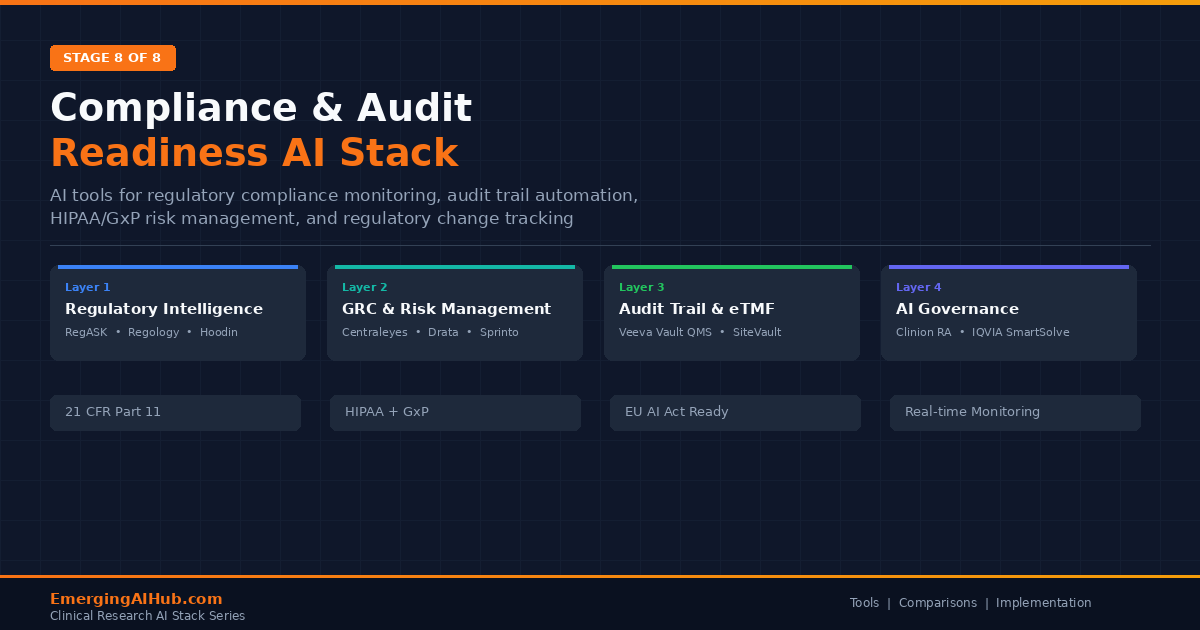
The compliance stack has four layers: a feasibility and data platform for tracking regulatory changes globally, a GRC and risk management system for operationalizing controls, an audit trail and eTMF compliance layer for maintaining inspection readiness, and an AI governance and validation framework for managing the compliance of AI tools used across the trial. Here’s how the leading tools map to each layer.
Layer 1: Regulatory Intelligence and Change Management
Primary recommendation: RegASK
RegASK is an AI-driven regulatory intelligence platform that monitors regulatory changes across more than 160 countries, automatically classifying updates by product type, therapeutic area, and regulatory domain. For clinical research teams, its core value is automated change detection: when the FDA issues new guidance on AI in drug development, or the EMA updates its clinical trial regulation, RegASK surfaces the change, assesses its impact on your operations, and routes it to the right team members — all without manual monitoring.
What makes RegASK particularly strong for clinical research compliance is its agentic workflow orchestration. Rather than simply alerting you to changes, the platform helps you operationalize the response — mapping new requirements to existing controls, identifying gaps, and tracking remediation actions through to completion. RegASK reports that clients using its platform have seen a 40% increase in operational efficiency and a 60% reduction in time spent handling regulatory tasks.
RegASK also includes label review capabilities and a global regulatory database, making it useful beyond just clinical trials — it supports the full product lifecycle from development through post-market surveillance.
When to consider alternatives: Regology offers a similar regulatory change management capability with a strong focus on U.S. healthcare regulations (FDA, CMS, HIPAA). Its strengths are in automated audit trail capture for every regulatory update and team notification workflows. For organizations with complex multi-framework compliance needs that extend beyond clinical trials — such as hospitals or health systems managing HIPAA alongside clinical research obligations — Regology’s broader healthcare focus may be more appropriate. Hoodin is another option for teams that need regulatory intelligence combined with scientific literature monitoring, particularly useful for pharmacovigilance and safety-related compliance.
Layer 2: Governance, Risk, and Compliance (GRC) Platform
Primary recommendation: Centraleyes
Centraleyes is an AI-powered GRC platform that unifies compliance management across HIPAA, HITECH, NIST, SOC 2, ISO 27001, and over 180 other frameworks. For clinical research organizations, its value lies in cross-framework risk management: rather than managing HIPAA, GxP, and 21 CFR Part 11 obligations in separate systems, Centraleyes maps shared controls across all applicable frameworks and automates evidence collection, risk assessment, and audit reporting from a single dashboard.
The platform’s AI capabilities assist with updating the risk register, suggesting control mappings, drafting policy language, and surfacing remediation paths. Automation handles assessments, evidence collection, and reporting — turning what was historically weeks of manual audit preparation into a continuously maintained compliance posture. Healthcare organizations using the platform report being able to run a full risk assessment in under 30 days and maintaining real-time audit readiness.
For clinical research specifically, Centraleyes’ strength is handling the overlap between IT security compliance (HIPAA, NIST) and clinical compliance (GxP, ICH-GCP). Most clinical trials now involve cloud-hosted EDC systems, remote monitoring platforms, and AI tools — all of which create both IT security and clinical compliance obligations. Centraleyes bridges that gap.
When to consider alternatives: Drata is strong for organizations that need continuous monitoring across a large tech stack, with integrations to over 200 systems. Vanta is widely used in health tech startups and offers a streamlined path to SOC 2 and HIPAA compliance, though it’s less healthcare-specialized than Centraleyes. For organizations that are primarily focused on HIPAA compliance without the broader GxP layer, Sprinto offers a lighter-weight option with guided implementation and automated evidence collection.
Layer 3: Audit Trail, eTMF, and Inspection Readiness
Primary recommendation: Veeva Vault Clinical Operations (eTMF + QMS)
Veeva Vault is the industry standard for clinical trial document management, and its compliance capabilities are deeply embedded across the platform. The eTMF (electronic Trial Master File) application maintains a complete, inspection-ready record of all trial-related documents with automated completeness tracking, version control, and 21 CFR Part 11 compliant electronic signatures and audit trails. Veeva Vault QMS (Quality Management System) handles deviations, CAPAs (corrective and preventive actions), change control, and inspection management — all connected within the same platform.
What sets Veeva apart for compliance is the connected data model. A protocol deviation tracked in the QMS is linked to the relevant trial documents in the eTMF, which connects to the regulatory submission in Vault Submissions. This traceability is exactly what inspectors look for, and it eliminates the manual cross-referencing that causes findings during audits. More than 600 biopharma companies use Veeva’s quality applications, making it the most widely adopted platform in the industry.
Veeva’s Disclosures add-on is particularly relevant for compliance: it centralizes clinical trial disclosure management and accelerates registry submissions across global regulations, reducing the risk of transparency requirement violations.
When to consider alternatives: For research sites (as opposed to sponsors or CROs), Veeva SiteVault provides a free eTMF and eConsent solution integrated with sponsor systems. Montrium eTMF Connect is a strong option for mid-sized organizations that need eTMF capabilities without the full Veeva ecosystem commitment. For organizations using Medidata for clinical operations, Medidata’s Rave platform includes its own audit trail and compliance capabilities that may reduce the need for a separate compliance layer.
Layer 4: AI Governance and Validation
Primary recommendation: Clinion’s Responsible AI Framework + IQVIA SmartSolve
As AI tools are deployed across the clinical trial lifecycle, governing those tools becomes a compliance requirement in itself. The FDA-EMA joint guiding principles released in January 2026 established ten key principles for AI in drug development, including mandating that data scientists are integrated with clinical leads throughout the lifecycle and requiring continuous monitoring for data drift.
Clinion — already represented in the protocol design and regulatory submissions stacks — has built a Responsible AI framework anchored in four pillars: accountability (clear ownership of AI-enabled decisions), transparency (explainable models with documented decision logic), privacy and security (robust data protection aligned with global regulations), and fairness (active bias identification and mitigation). These principles are increasingly scrutinized during inspections and sponsor due diligence processes.
IQVIA SmartSolve provides the operational infrastructure for AI governance: quality management, regulatory compliance, and training management in a single system. For clinical research organizations deploying multiple AI tools across their workflow, SmartSolve offers the structured documentation, change management, and validation tracking needed to demonstrate that each AI tool meets GxP and regulatory requirements.
When to consider alternatives: Formly offers AI-powered compliance change management specifically for EU MDR and US FDA medical device regulations, making it particularly relevant for trials involving AI-powered medical devices or Software as a Medical Device (SaMD). For organizations that need to validate AI models used in clinical decision-making, the MONAI Model Zoo (covered in the medical imaging stack) provides pre-validated model architectures that reduce the validation burden for imaging AI.
Tool Comparison Matrix
| Feature | RegASK | Centraleyes | Veeva Vault QMS | Clinion RA Framework | IQVIA SmartSolve |
|---|---|---|---|---|---|
| Primary function | Regulatory intelligence | GRC + risk management | QMS + eTMF compliance | AI governance | Quality + compliance ops |
| Regulatory change tracking | Strong (160+ countries) | Moderate (framework-mapped) | Limited (via integrations) | Limited | Moderate |
| Audit trail automation | N/A | Strong (evidence collection) | Strong (21 CFR Part 11) | N/A | Strong |
| Risk-based monitoring | Moderate (impact scoring) | Strong (AI-driven risk register) | Strong (deviation tracking) | Moderate | Strong |
| Multi-framework support | Strong (global regs) | Strong (180+ frameworks) | GxP/ICH-GCP focused | AI Act / FDA AI guidance | GxP + ICH + FDA |
| AI governance support | Limited | Moderate (AI tool risk) | Limited | Strong | Strong (validation mgmt) |
| Best for | Global regulatory monitoring | Cross-framework compliance | eTMF + inspection readiness | AI tool compliance | Enterprise quality ops |
| Integration points | Standalone SaaS | API integrations (200+) | Veeva ecosystem | Clinion eClinical suite | IQVIA ecosystem |
| Pricing model | Enterprise subscription | Per-module subscription | Enterprise subscription | Included in Clinion platform | Enterprise subscription |
Implementation Guide: Building Your Compliance AI Stack
Step 1: Map Your Regulatory Obligation Landscape
Before selecting tools, inventory your compliance obligations. Most clinical research organizations operate under at least four overlapping regulatory frameworks: ICH-GCP for trial conduct, 21 CFR Part 11 for electronic records and signatures, HIPAA for patient data protection, and GxP for systems used in regulated processes. If you operate in the EU, add the EU Clinical Trials Regulation, GDPR, and as of August 2026, the EU AI Act’s high-risk provisions for AI-enabled medical devices. Map each framework to your current tools and processes to identify gaps, overlaps, and manual bottlenecks.
Step 2: Start with Regulatory Intelligence (Fastest Time-to-Value)
If you’re building a compliance stack from scratch, start with a regulatory intelligence platform like RegASK or Regology. The integration risk is minimal (standalone SaaS, no system dependencies), and the immediate benefit is eliminating the manual monitoring of regulatory changes. Configure the platform to track the specific jurisdictions, therapeutic areas, and regulatory domains relevant to your trials. Measure success by the reduction in time your regulatory affairs team spends on manual change tracking.
Step 3: Layer in GRC for Cross-Framework Risk Management
Once you have regulatory intelligence flowing, operationalize it with a GRC platform like Centraleyes. The goal is to connect regulatory changes to your internal controls — when a new HIPAA requirement takes effect, the GRC platform should automatically identify which controls need updating, assign remediation tasks, and track completion. This layer is particularly valuable for organizations juggling both IT security and clinical compliance obligations.
Step 4: Consolidate eTMF and QMS on a Single Platform
For inspection readiness, the eTMF and QMS must be tightly integrated. If you’re already using Veeva for clinical operations, extending to Vault QMS is the natural path. If you’re evaluating platforms, prioritize the connection between your quality events (deviations, CAPAs) and your trial master file — inspectors consistently check whether corrective actions were documented, implemented, and verified across the relevant trial documents.
Step 5: Establish AI Governance Before Scaling AI Adoption
The most forward-looking step is establishing your AI governance framework before you deploy additional AI tools across your trial workflow. As the EU AI Act’s high-risk provisions begin to apply in August 2026, organizations using AI in clinical contexts will need documented governance structures including risk classification, validation evidence, bias monitoring, and ongoing performance tracking. Getting this infrastructure in place now avoids a costly retrofit later.
Step 6: Connect to the Full Clinical Research Stack
Compliance doesn’t exist in isolation — it connects to every other stage of the clinical workflow. Your protocol design tools should generate audit-ready documentation. Your safety monitoring system should automatically log adverse events to compliance-compliant formats. Your regulatory submission tools should pull from a validated, version-controlled document repository. When the compliance stack is integrated with the other seven stages covered in this series, compliance becomes a continuous property of the workflow rather than a separate activity.
Workflow Automation: Connecting Compliance to Your Broader Stack
For teams using workflow automation tools like Make.com, several compliance workflows can be automated:
Regulatory change response automation. When RegASK or Regology detects a relevant regulatory change, automatically create a task in your project management system, notify the appropriate compliance lead, and generate a gap analysis template pre-populated with the change details and your current control mappings.
Deviation-to-CAPA pipeline. When a protocol deviation is logged in your clinical operations system, automatically trigger a root cause analysis workflow, assign the CAPA to the responsible party, and set follow-up milestones. Link the deviation record to the relevant documents in your eTMF for inspection traceability.
Inspection readiness dashboards. Aggregate data from your eTMF, QMS, and training management system into a real-time inspection readiness dashboard. Automate weekly completeness checks and route gap notifications to the responsible team before a backlog builds.
AI tool validation tracking. Monitor each AI tool in your clinical workflow for version changes, model updates, or performance drift. When a vendor releases a new version, automatically trigger a revalidation assessment and log it in your quality system.
Compliance meeting documentation. Use Fireflies.ai to automatically transcribe and summarize compliance committee meetings, quality review boards, and inspection preparation sessions. Meeting minutes are auto-generated and stored in your document management system with timestamps and action items.
Literature monitoring for compliance intelligence. Use Elicit to set up automated searches for new publications on clinical trial compliance, AI governance in healthcare, and regulatory enforcement trends — feeding directly into your compliance team’s intelligence workflow.
These automations don’t require engineering resources — Make.com’s visual workflow builder lets clinical operations teams configure these integrations directly.
Compliance & Security: Compliance Tools
Compliance tools handle some of the most sensitive data in your organization — audit logs, quality events, regulatory correspondence, and inspection findings. Before deploying any tool in this stack, your IT security and compliance teams should evaluate these considerations.
Veeva Vault QMS and IQVIA SmartSolve are validated for 21 CFR Part 11 compliance, supporting electronic signatures and complete audit trails required for FDA-regulated quality records. Ensure your instance configuration maintains validated status through your organization’s CSV (Computer System Validation) process.
GRC platforms like Centraleyes and Drata should provide current SOC 2 Type II reports demonstrating the operational effectiveness of their own security controls. Request the most recent report and penetration test summary before onboarding.
For organizations conducting trials in the EU, verify data residency options for each platform. Compliance data — particularly regulatory correspondence and quality records — may need to remain within EU data centers to satisfy GDPR requirements.
Confirm each vendor’s BAA (Business Associate Agreement) status if any PHI is involved. For AI governance tools, verify that the vendor’s own AI practices are transparent and documented — you don’t want your AI governance platform to itself be a governance gap.
Note: Compliance requirements vary by organization, jurisdiction, and trial phase. This section provides a starting framework — always consult your organization’s regulatory affairs and IT security teams before deployment.
The Regulatory Landscape in 2026: What’s Changing
Several regulatory developments make the compliance stack more urgent in 2026 than in any prior year:
FDA-EMA joint AI guiding principles (January 2026). The FDA and EMA jointly released ten guiding principles for AI in drug development, establishing expectations for data provenance, model traceability, and continuous performance monitoring. Organizations using AI anywhere in their clinical development process should map their current practices against these principles.
EU AI Act high-risk provisions (August 2026). AI-enabled medical devices and clinical decision support tools will be classified as high-risk AI systems requiring formal conformity assessment and ongoing post-market monitoring. Clinical research organizations using AI for diagnostics, imaging analysis, or safety monitoring should begin preparing compliance documentation now.
HIPAA Security Rule updates. Updated HIPAA requirements are introducing mandatory multi-factor authentication, encryption for all ePHI, and annual security audits. Healthcare organizations must have systems updated to meet these standards, with vendor management practices aligned to the new requirements.
FDA draft guidance on AI for regulatory decisions. The FDA’s January 2025 draft guidance — now moving toward finalization — applies to AI used in nonclinical, clinical, manufacturing, and post-marketing phases. It excludes drug discovery research but covers any AI use that directly impacts product safety or study results.
ROI and Evidence: What the Data Shows
The evidence for AI-assisted compliance in clinical research is increasingly concrete:
- A major hospital network using AI-assisted compliance monitoring reported a 60% reduction in documentation errors and a 40% decrease in compliance incidents within one year of deployment. The system used NLP to automatically scan clinical records across multiple sites, flagging compliance issues before they could trigger enforcement actions.
- More than a third of organizations are already using AI in compliance and investigative workflows, with 73% citing time savings and 71% citing cost savings as primary drivers. Teams are expected to scale compliance without expanding headcount — making AI-assisted automation a practical necessity rather than an efficiency bonus.
- Healthcare data breaches cost an average of $7.42 million per incident in 2025, making proactive HIPAA compliance automation among the highest-ROI investments a clinical research organization can make. AI-powered continuous monitoring catches compliance risks before they become breach events.
- Organizations using automated regulatory intelligence platforms report that compliance teams recover 50% or more of the time previously spent on manual regulatory monitoring, freeing capacity for strategic compliance work — policy development, inspection preparation, and vendor qualification — that actually reduces risk.
The ROI case is strongest when compliance tools are integrated across the full trial stack rather than deployed in isolation. A connected compliance layer — where regulatory changes automatically flow to risk assessments, which trigger control updates, which generate audit-ready documentation — compounds the value of every individual tool investment.
What’s Next in This Series
This article covers the eighth and final stage of the clinical research AI workflow. The complete series includes:
- Protocol Design and Simulation
- Patient Recruitment and Matching
- Clinical Data Management
- Safety Monitoring and Pharmacovigilance
- Medical Imaging AI
- Regulatory Submissions
- Clinical Documentation and Scribing
- Compliance & Audit Readiness ← You are here
Return to the Complete AI Stack for Clinical Research for the full workflow overview, or use the AI Stack Builder to customize a stack for your specific use case.
Affiliate Disclosure: Some links in this article are affiliate links. EmergingAIHub may earn a commission at no extra cost to you when you use these links. We only recommend tools we’ve evaluated and believe add genuine value to clinical research workflows.
Published on EmergingAIHub.com | AI Workflow Intelligence for Healthcare Professionals
Last updated: March 2026
Navigate the Clinical Research AI Stack Series
← Previous: Clinical Documentation AI Stack